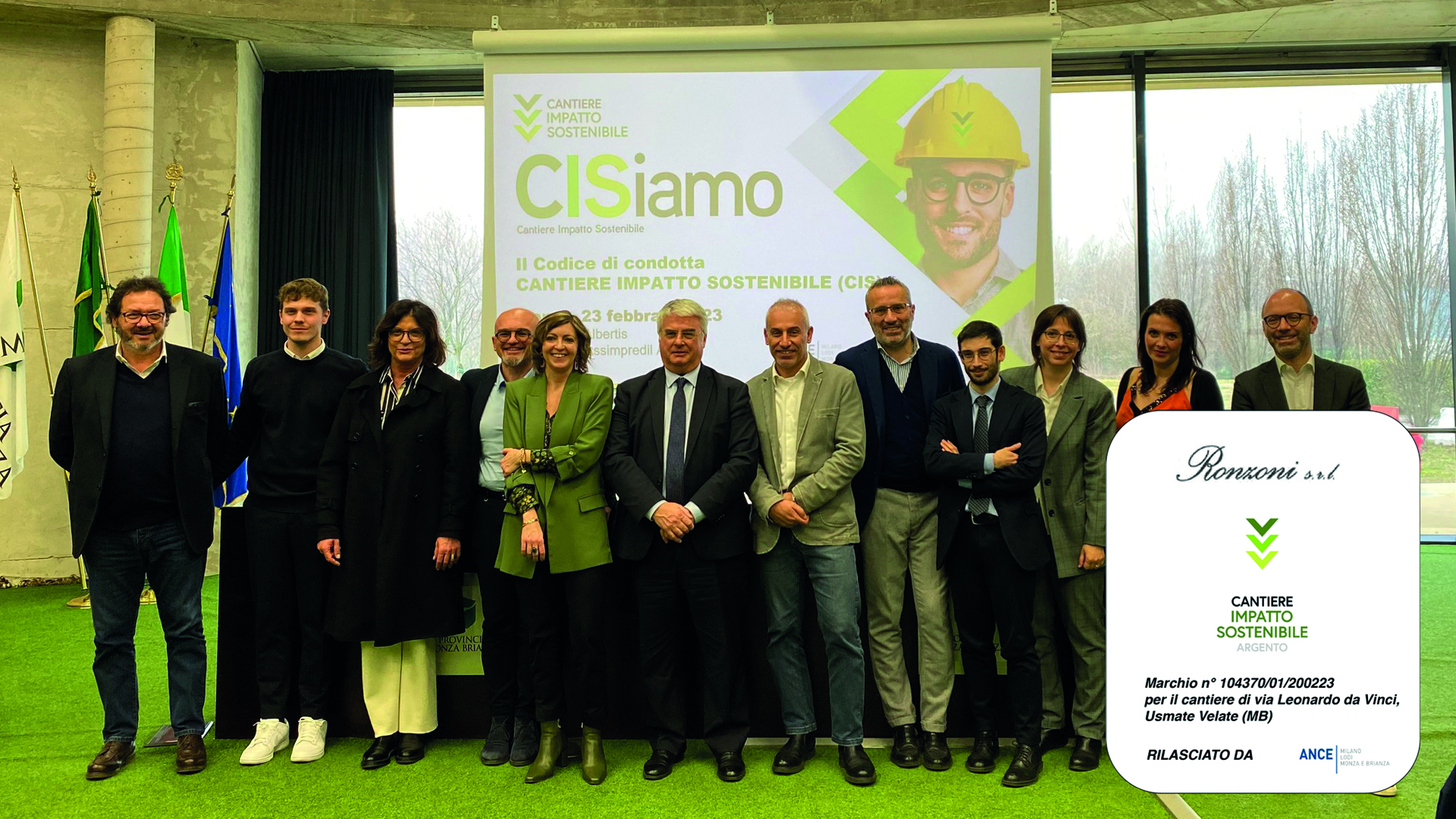
ANCE: The sustainable impact site presented
A challenge site by site in the name of sustainability.
Assimpredil Ance, the Association of construction companies and complementary of the ANCE system, National Association of Builders, Milan, Lodi and Monza Brianza, promotes a sustainable development implementation program for its members, which is the basis for any company voluntarily deciding to adhere to a “code of conduct”.
The Sustainable Impact Workshop is the Manifesto signed by Assimpredil’s partner Ance as a voluntary commitment to implement the code of conduct.
Construction and sustainable development
The new economy of sustainability, which has become an essential factor for the construction sector, introduces new approaches and practices aimed at combining aspects of growth and economic performance with social and environmental issues.
Actions for sustainability, in fact, have a significant impact on the creation of value of a company and, certainly, also redesign its production processes and products, from design to management, in relation to all stakeholders.
Sustainable development for construction starts from the need to regenerate built heritage, as a response to the demand for quality of habitat, health of places where people live and work, innovation in materials and technologies, infrastructure and public spaces. To adequately address this challenge, it is necessary to activate and include different disciplines, coordinating all the actors involved: designers, companies, clients, suppliers.
The “Planet – People – Profit” logic underlying the ESG criteria for sustainable investments (Environment, Social, Governance) has entered into market strategies: companies that have adopted a governance and management model in this direction have also paid great attention to the production phase, the sustainable construction site. There are a number of actions to improve the environmental impact of construction sites, for example by using fully renewable energy suppliers or by incurring ecosystem mitigation costs to offset their own CO2.
Feed their own construction site meters with certified energy from renewable sources, thinking about the development of renewable energy communities and net zero carbon are practices that are increasingly found and that register positive reactions in terms of attention from end consumers. A path of change in demand entirely in line with supply that measures the positive economic impacts for those companies that are investing in the green economy.
But not only, in fact, in the study phases that preceded the drafting of the text of “Cantiere Impatto Sostenibile”, it was found that the reduction of energy consumption and emissions pollutants and climate-related causes an increase in the driving capacity to innovate the territory, with many reference sectors on which to develop specific development strategies.
The design and construction of nearly zero energy buildings promote the development of technologies, materials and production methods with decreasing impact on the environment. They are also pushing to experiment with the recovery of construction and demolition materials, with effects on the circular economy.
The construction of new infrastructure works, in which technologies can be adopted that make use of materials derived from recovery processes, not only eliminates the use of virgin material but activates the industrial market for recovery.
The energy efficiency of existing buildings, including condominiums and large real estate, also entails the requalification of functional deficiencies, the elimination of architectural barriers, Prevention and structural adaptation to seismic and fire phenomena.
The structure of the supply chain
The construction industry is facing this transformation according to the logic of measurable steps.
It is a long chain that crosses 80% of all sectors and activates 20% of the country’s GDP. Construction companies account for almost 12% of the entire production system in Italian industry and services.
The Lombardy buildings are almost 20% of the productive offer of the sector at national level and are concentrated for about 27% in the Metropolitan City of Milan.
For this sector, talking about ecological transition means reflecting on the impact of the change of pace, first of all cultural, in lifestyles and in the market.
The expression “ecological transition” is itself a method: it is a path to be followed and a work to be done at the level of the supply chains, in a synchronous way.
For more information click here.